Overview
What tomboy means.
A tomboy is a girl or young woman who does things her culture files under boys: the clothes, the games, the way of carrying herself. That is Wikipedia's plain definition and it is the one most people mean. The community wiki adds the modern gloss, a gender non-conforming girl or feminine-aligned person who presents masculinely in some way, and says outright that the word is about presentation more than identity.
So this page will not tell you tomboy is a gender. It is a way of being a girl. Most tomboys are girls or women with no question about it. Some grow up to be butch, some to be trans men, some to be non-binary, and most to be women who kept the trainers. The word cannot tell you which, and Wikipedia is clear that boyish behaviour in girls is not an indicator of sexual orientation or of future gender.
The word is old and has moved. The Oxford Dictionary of English, as cited on Wikipedia, has it meaning a rude, boisterous boy in 1533, a bold or immodest woman by the 1570s, and a girl who behaves like a spirited boy by around 1600. It has carried a lesbian connotation for much of the twentieth century and a stubborn myth that it is a phase you are meant to grow out of. Neither is the definition. What it is not: not butch, which has a queer history attached; not femboy, its counterpart; not a diagnosis of anything.
A girl or woman with boyish presentation and interests; the classic presentation word that is not a gender identity.
Tomboy in one line
Origin
Where the word comes from
Tomboy has no single coiner; it is a centuries-old English compound of tom, an everyman's name long used for boldness or ordinariness, and boy. The Oxford Dictionary of English's citation history, as recorded on Wikipedia, traces it from a rude, boisterous boy in 1533, to a bold or immodest woman by the 1570s, to a girl who behaves like a spirited boy by around 1600 — the word crossed from describing boys, to describing unruly women generally, to its familiar modern sense within about seventy years.
From the seventeenth century onward it settled into describing girls specifically, and picked up a durable, unproven association with lesbianism over the twentieth century as clinicians and popular writers speculated about "masculine" girls growing into gay women — a link that later research, including work cited on Wikipedia, found no reliable evidence for.
Signs people describe
Common experiences
None of these is a test. Most people recognise a few and shrug at the rest.
You were the girl in the football game at break, and the one told to sit like a lady at the wedding, sometimes on the same day.
Dresses were something that happened to you.
Trousers were something you chose.
You had a stretch, around eleven or twelve, when the adults stopped finding it charming and started finding it a problem.
Being called one of the lads was a compliment until it wasn't, and you can remember the day it turned.
Someone has assumed you were gay because of the way you dress.
Someone else has assumed you were straight because of the way you dress. Same outfit.
You have been asked, kindly, whether you might be trans, and the honest answer was: no, I'm a girl, I just do it like this.
You still buy from the men's section because the pockets are real, and you stopped explaining it years ago.
The word feels a bit childish for a grown woman and you use it anyway, because the alternatives all come with a history you did not sign up to.

Pronouns
Pronouns
She/her, almost always, and she is not doing it wrong. Some adult tomboys use they/them. If someone tells you their pronouns, that is the answer; the haircut is not.
Consider another path
This might not be your word if…
- 1Girl is the part that does not fit. Tomboy keeps the girl. If the wrongness is about being a girl at all, read transmasculine and trans man.
- 2The masculinity is load-bearing, how you want to be looked at and who you are to the person you love, and it grew up in queer spaces. That is butch, and it will hold more weight.
- 3You are looking for a gender identity. This is not one. You can be a tomboy and have the whole gender question still open.
- 4Someone else is calling you this to make your gender smaller, just a tomboy, and it does not describe you. You do not have to accept delivery.
Close by
Related identities
Butch
Masculinity grown inside queer life, with dyke-bar history and erotic weight. Tomboy has none of that attached and is widely used by straight women. If tomboy covers the whole feeling, it is simply the accurate word.
ReadFemboy
The counterpart the record names: a boy or man who presents femininely. Same logic, opposite direction, and equally not a gender.
ReadMasc
Masculine presentation for anyone, adult and neutral. If tomboy sounds like something you were at nine, masc is the grown-up word for the same wardrobe.
ReadGender nonconforming
The general term: presentation that breaks the expectations for your gender. Tomboy is the specific, girl-shaped version everyone already knows.
ReadBoi
Masculine but not a man, and not a woman either. If womanhood is intact underneath for you, tomboy is closer; if it is not, boi and the pages near it are worth reading.
ReadTomboy, side by side
Questions people ask
Frequently asked questions
Is tomboy a gender identity?+
No. It is a presentation: a girl or woman who does boyish. The community wiki says it has more to do with presentation than identity, and Wikipedia defines it by behaviour and clothes. Tomboys are girls and women; a few later find another word, most do not.
Does being a tomboy mean I'm gay or trans?+
No. Wikipedia says plainly that boyish behaviour in girls is not an indicator of sexual orientation or of future gender presentation. Plenty of lesbians were tomboys; plenty of tomboys are straight; some are trans men later. The word predicts none of it.
Is it something you grow out of?+
Some do, some don't. Wikipedia notes the expectation, in Western culture, that tomboys will drop it at puberty, and Jack Halberstam's point that the same behaviour tolerated in young girls is often punished in adolescents. Adult tomboys exist and need no permission.
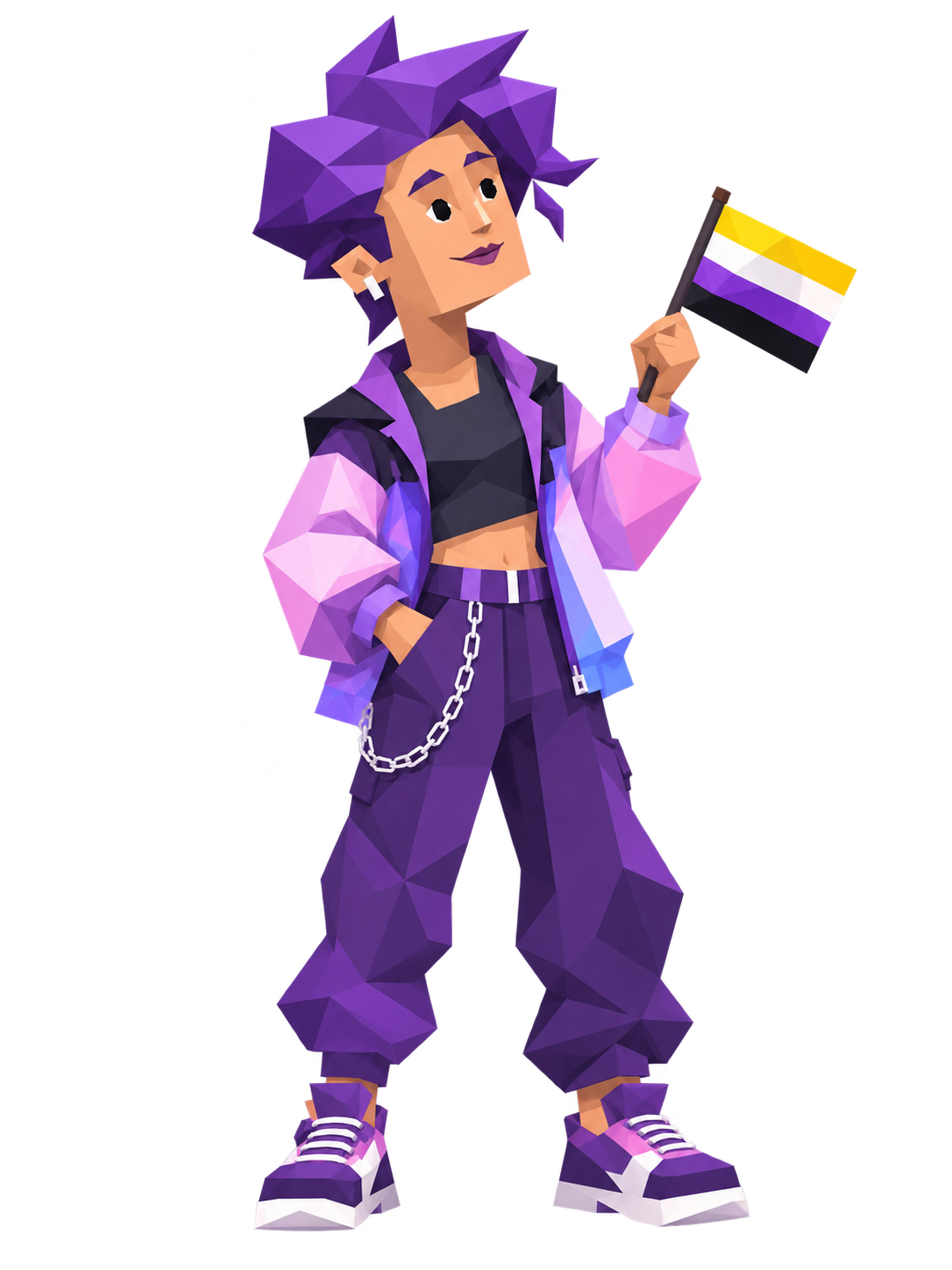
The flag
Designer unknown — lgbtqia.wiki says only that the flag was first posted to the Lesbians Unite Amino on 2017-04-28 (post not fetchable); gender.fandom.com credits beyond-MOGAI-pride-flags on an unknown date.
Sources
- Tomboy — LGBTQIA+ Wiki Fetched. Definition (also mascgirl; gender non-conforming girls presenting masculinely), the statement that it is about presentation more than identity, and femboy as the counterpart.
- Tomboy — Wikipedia Fetched. Plain definition; Oxford Dictionary of English etymology (1533, 1570s, late 1590s); child development section stating tomboy behaviour is not an indicator of orientation or future gender; gender roles section citing Jack Halberstam; sexual orientation section on the lesbian association and the misconception.
Still figuring things out?
Twenty questions, four minutes, and a few words worth trying on.